
Math Advance in Fluid Dynamics Unlocks New Industrial AI
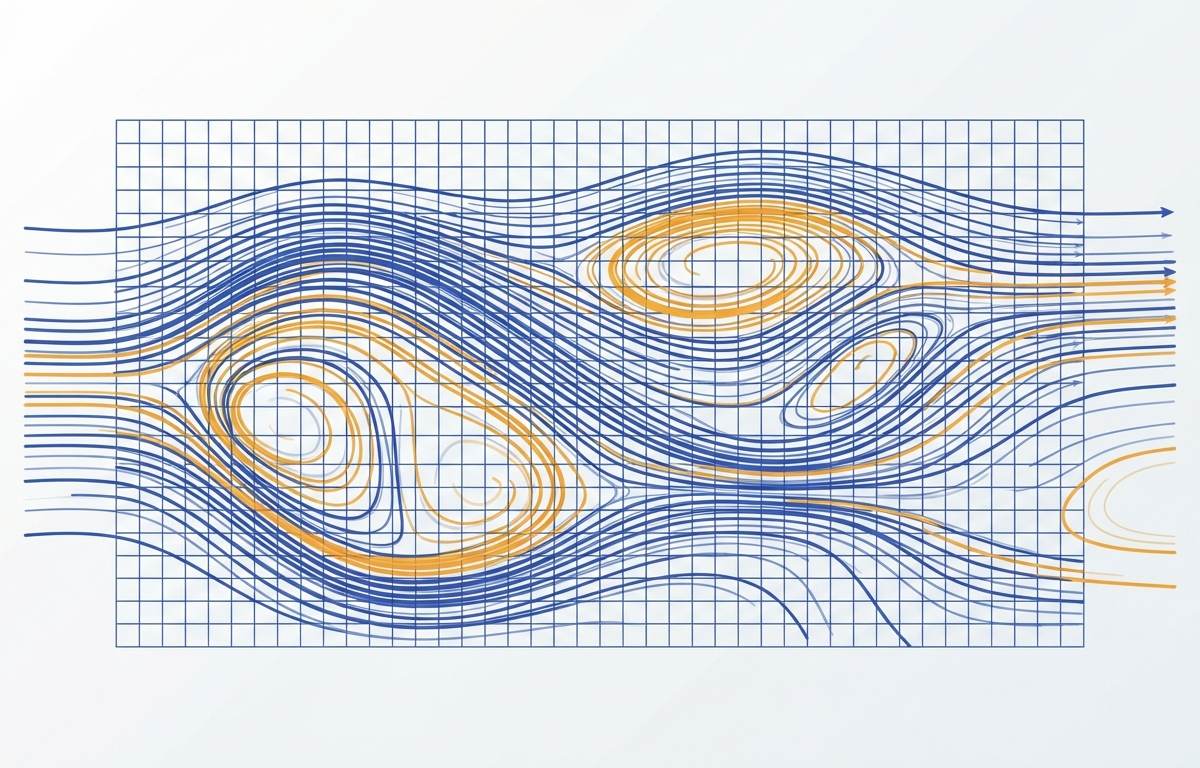
Mathematician Tristan Buckmaster has released pivotal findings addressing the longstanding Navier-Stokes equations, which govern how fluids like water, air, and crude oil flow. For decades, predicting turbulence and potential computational singularities in fluid motion has remained one of physics and mathematics' most complex hurdles, frequently limiting the speed and reliability of engineering simulations.
The practical implications of refining these fluid models stretch far beyond theoretical academia. Modern aerospace, climate modeling, maritime shipping, and petrochemical refining rely heavily on numerical fluid dynamics that demand vast supercomputing resources. Refining the underlying mathematical foundations enables software developers to build lighter, vastly more efficient algorithms that reduce computational overhead while maintaining high fidelity.
Today, this mathematical progress directly fuels the rise of physics-informed neural networks and industrial digital twins. By embedding mathematically robust fluid laws into machine learning models, enterprise software can now predict aerodynamic drag, pipeline pressure drops, and thermodynamic changes in real time rather than requiring days of brute-force computational processing.
For Oman and the wider Gulf region, where energy logistics, maritime trade, and green hydrogen projects form the economic backbone, faster fluid modeling delivers immediate commercial value. Industrial operators in industrial hubs like Sohar, Salalah, and Duqm can leverage these next-generation simulation tools to preempt pipeline fatigue, streamline vessel hull performance, and optimize cooling systems for data centers and refineries under harsh climates.
Business leaders and digital engineering teams across the GCC should evaluate their legacy simulation software and explore modern platforms augmented by physics-based artificial intelligence. Adopting mathematically optimized digital twins allows regional enterprises to trim operating expenses, protect critical assets, and align their engineering operations with national sustainability objectives under Oman Vision 2040.