AI Designs a New CPU: What Frostbite Means for Tech
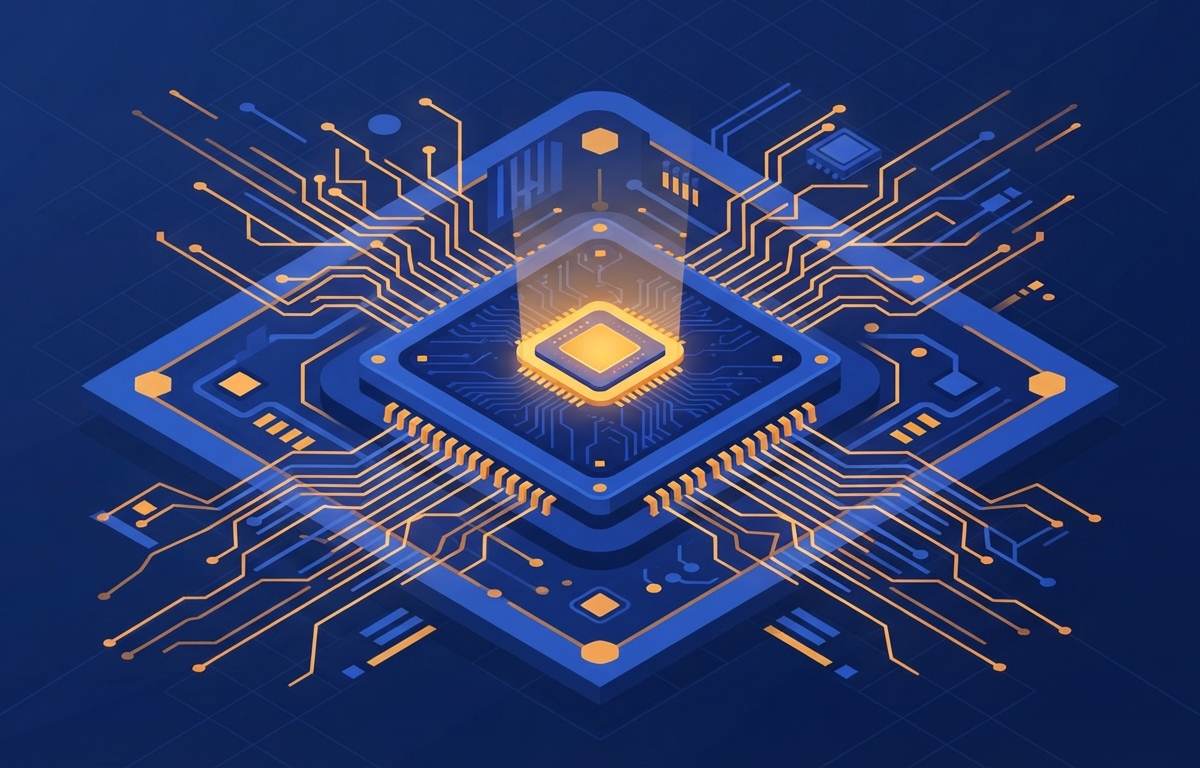
Researchers have unveiled Frostbite, an entirely new central processing unit architecture autonomously discovered, synthesized, and verified by artificial intelligence. Rather than relying on human engineering teams spending years drafting instruction sets, floorplans, and logic gates, AI systems explored novel hardware paradigms and mathematically proved their viability in a fraction of traditional development cycles.
This breakthrough fundamentally challenges the legacy semiconductor paradigm. Chip design and verification have historically represented one of the most capital-intensive bottlenecks in global technology, concentrated among a tiny group of multinational hardware giants. By demonstrating that autonomous models can execute end-to-end architectural engineering, the technical and financial barrier to creating custom, application-specific silicon is beginning to fall.
Beyond development speed, AI-designed hardware directly tackles the escalating energy crisis within enterprise computing. Modern enterprise workloads, spanning large-scale data analytics to complex business automation, require massive amounts of electrical power. Architectures shaped directly by machine learning can optimize pipeline depth and power consumption with mathematical precision, opening the door to cloud infrastructure that delivers substantially greater computational throughput per watt.
For Oman and the wider Gulf region, this milestone aligns closely with multi-billion-dollar investments in national cloud infrastructure, green data centers in Muscat and Salalah, and sovereign digital strategies under Oman Vision 2040. As regional enterprises scale their cloud footprints and digital services, the emergence of AI-optimized hardware will drive down hosting, transaction, and data processing costs for local digital platforms, financial institutions, and logistics operators.
For business leaders and decision-makers across the GCC, the practical takeaway extends far beyond physical silicon. Frostbite confirms that artificial intelligence is transitioning from a conversational interface into an autonomous execution partner capable of solving intricate systems engineering problems. Forward-thinking organizations should assess their core operational workflows now, identifying where domain-specific automation and AI agents can eliminate operational bottlenecks, modernize legacy systems, and deliver sustainable cost savings.